Lillyanstar Script Font for Handmade Brands
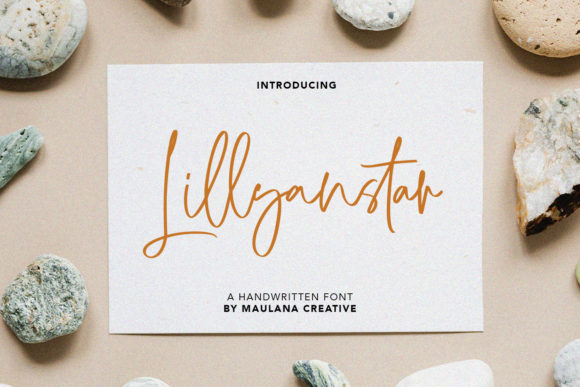
As a maker who designs printable wedding suites, hand-stamped tags, and custom candle labels, I know how much a single font can shape how customers experience my work. That’s why Lillyanstar has become one of my go-to script fonts — not just for its beauty, but for how reliably it translates across physical and digital products. It’s a refined script font with graceful curves, subtle contrast in stroke weight, and a quiet confidence that reads as both timeless and refreshingly modern.
What makes Lillyanstar stand out isn’t just elegance — it’s intentionality. The letterforms are carefully spaced and balanced, so even at small sizes (like 8–10 pt on product tags or jar labels), the characters stay legible without losing their charm. There’s no excessive flourish that gets lost in cutting or printing — no awkward joins or overextended swashes that snag on vinyl weeding or misfire on inkjet printers. If you’ve ever struggled with a script font that looks stunning on screen but turns muddy on kraft paper or faint on matte sticker stock, you’ll appreciate how thoughtfully Lillyanstar was built for real-world craft use.
I reach for Lillyanstar when I need warmth and sophistication without sacrificing clarity. It works beautifully on:
- Candle and soap labels — especially paired with a clean sans serif for ingredients or scent notes;
- Wedding welcome signs and place cards — where guests first encounter your brand’s tone;
- Boutique gift tags and packaging ribbons — adding handmade polish to retail-ready items;
- Digital printables like planner covers, quote art, and greeting card templates — where readability and visual harmony matter for both screen preview and printed output;
- SVG files for Cricut and Silhouette users — the smooth vector outlines cut cleanly, even at 1.5" height;
- Mugs, tote bags, and tea towels — thanks to its sturdy x-height and open counters that hold up under heat press or screen print;
- Farmhouse-style wall art and seasonal decor — think “Gather,” “Homegrown,” or “Joyful” in soft sage and cream.
One thing I love about Lillyanstar is how well it supports consistent branding. Whether I’m designing a full stationery suite — from save-the-dates to thank-you cards — or building a cohesive set of digital downloads for Etsy, this font gives me visual continuity without feeling repetitive. Its rhythm feels natural, not mechanical, and it carries emotional weight: “Hand-poured,” “Small-batch,” “Made with love” — those phrases land differently in Lillyanstar.
For readability on physical goods, keep these practical tips in mind:
- Use Lillyanstar for short, high-impact text only — names, titles, taglines, monograms. Avoid body copy or long paragraphs.
- When layering on vinyl or printable sticker sheets, increase letter spacing slightly (by 20–40 units in design software) to prevent overlapping strokes — especially with lowercase “e,” “a,” and “o.”
- Test print or cut at your intended final size before batching — some scripts blur below 12 pt on thermal printers or lose definition on low-res mockups.
- For signage or large-format prints, pair Lillyanstar with a grounded sans serif like Montserrat or Poppins — not too light, not too bold — to anchor the composition and guide the eye.
Font pairing is where Lillyanstar truly shines. As a premium script font from Script Amp, it’s designed to complement — not compete with — supporting typefaces. I most often pair it with a friendly, medium-weight sans serif for product descriptions, ingredient lists, or copyright lines. For vintage-inspired collections, I’ll swap in a delicate serif like Playfair Display — but always keep Lillyanstar as the sole display voice. Too many decorative fonts dilute impact; one strong script, well-placed, says more.
The Lillyanstar package includes OpenType features you’ll actually use: standard ligatures for smoother “fi,” “fl,” and “ff” connections, alternate lowercase “g” and “y” forms for subtle variation, and optional swashes on select capitals — perfect for opening letters in invitations or monogrammed embroidery patterns. It’s delivered in .OTF and .TTF formats, compatible with Canva, Adobe Creative Cloud, Cricut Design Space, Silhouette Studio, and Affinity apps. While it doesn’t include extended Latin or Cyrillic glyphs, it fully supports English, Spanish, French, and German diacritics — enough for most small-batch labels and bilingual wedding wording.
Before using Lillyanstar commercially — whether on physical products you sell, digital templates you list on Etsy, SVG files for crafters, or client-branded assets — double-check your license. This is a commercial font, and the standard license permits unlimited physical and digital sales of end products (no credit required). You may not resell or redistribute the font file itself, embed it in unsecured web fonts, or use it in apps or SaaS platforms without an extended license. As someone who’s burned by unclear licensing before, I treat this step like checking thread count before ordering fabric — non-negotiable.
If you’re curating a collection of reliable, customer-pleasing typefaces for your shop, Lillyanstar earns its place not just for how it looks, but for how consistently it performs. It adds quiet luxury to a $6 sticker sheet and gravitas to a $250 wedding suite — same font, same integrity. In a market where handmade buyers respond to authenticity and care, Lillyanstar helps your typography whisper, “This was made with attention,” before a single word is read.