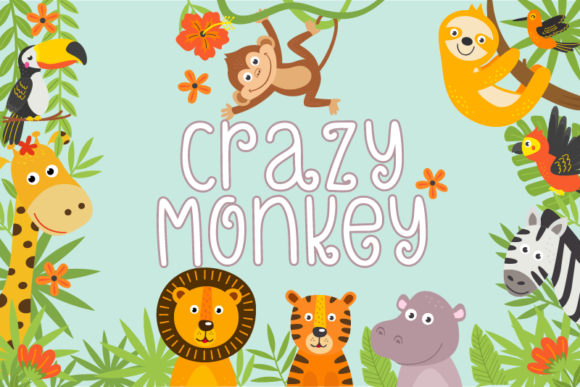
Crazy Monkey: A Whimsical Handwritten Font for Real Business Branding
As a small business owner who designs my own packaging, social posts, and website banners, I’ve learned that typography isn’t just about “looking pretty”—it’s about showing up consistently, authentically, and professionally across every customer touchpoint. That’s why Crazy Monkey quickly became one of my most-used design assets from the Script Amp collection. It’s not another generic script font. It’s a playful, confident, handwritten typeface with real personality—yet it stays legible, versatile, and unmistakably intentional.
Crazy Monkey has that rare balance: whimsy without clutter, elegance without stiffness. The letterforms flow like confident pen strokes—slightly bouncy, gently connected, with subtle variations in stroke weight and rhythm. It feels handmade but never messy. That makes it ideal for businesses that want warmth and charm without sacrificing polish—think a boutique candle brand, a plant-based skincare line, a cozy neighborhood café, or a freelance coach whose messaging centers on joy and authenticity.
In practice, I use Crazy Monkey as a display font, not body text. It shines brightest where attention matters most: your logo, product labels, Instagram story headers, thank-you card headlines, and website hero banners. On a lavender-scented soy candle jar, Crazy Monkey on the front label gives instant character—soft enough to feel calming, bold enough to stand out on a crowded shelf. On a digital ad for my seasonal workshop series, pairing it with a clean sans serif (like Montserrat or Inter) creates contrast that guides the eye while keeping the message clear and scannable.
Readability is something I test early—and Crazy Monkey delivers where it counts. At 24pt and above, it reads cleanly on printed menus, stickers, and business cards. On mobile screens, it holds up well in Instagram post headers and Pinterest graphics when used at appropriate sizes and with sufficient spacing. I avoid using it below 16pt for print or 18pt for web—especially on small product tags or QR code labels—because its expressive connections need breathing room to stay legible.
Consistency is where Crazy Monkey truly pays off. When I first launched my ceramic studio, I used three different fonts across my website, packaging, and Instagram highlights—and customers told me the brand felt “scattered.” Switching to Crazy Monkey as my primary accent typeface (paired with a neutral sans serif for all supporting text) unified everything overnight. My logo, order confirmation emails, and even hand-written-style email subject lines now share the same visual heartbeat. That repetition builds recognition—without saying a word.
Real-world examples help clarify how flexible it is. A local bakery uses Crazy Monkey for their chalkboard-style menu board header and custom cupcake box stamps—then switches to Open Sans for ingredients and pricing. A handmade jewelry seller applies it to her Etsy shop banner and gift box ribbon labels, but keeps product descriptions in Lora for quiet sophistication. A wellness coach features Crazy Monkey in her lead magnet cover and podcast episode thumbnails, then uses a crisp geometric sans for timestamps and bullet points. In each case, the font supports voice—not overrides it.
Font pairing is simple but strategic. Crazy Monkey pairs beautifully with clean, modern sans serifs (for clarity and contrast) or soft, readable serifs (for warmth and depth). Avoid pairing it with other decorative scripts—that dilutes impact. Stick to one strong display font and one reliable workhorse. I keep a short list in my brand style guide: Crazy Monkey + Inter for digital-first brands; Crazy Monkey + Merriweather for service-based or lifestyle businesses that lean into storytelling.
Before rolling Crazy Monkey across your entire brand, test it in context. Print a mock-up of your product label at actual size. Preview your Instagram carousel on a phone screen. Paste the font into your email platform and send a test to yourself. Does it render smoothly? Does it reflect the tone you want to convey—friendly but not childish, creative but not chaotic? If yes, you’re ready to go further.
Licensing matters—especially if you’re selling physical goods or digital templates. Crazy Monkey is a commercial font, and the Script Amp license covers use in logos, packaging, merchandise, client projects, and digital downloads—as long as you’ve purchased the proper license tier. Always double-check the license terms before applying it to product labels, Shopify themes, Canva templates, or printable planners you plan to sell. It’s a small step that protects your business and respects the designer’s work.
What sets Crazy Monkey apart isn’t just how it looks—it’s how it behaves across your business ecosystem. It doesn’t shout. It invites. It adds humanity to a receipt, warmth to a shipping label, and distinction to a crowded marketplace—all while staying grounded in real usability. For small business owners juggling design, operations, and customer care, that kind of reliability is priceless.
If your brand thrives on approachability, artistry, or joyful intention—and you’re tired of fonts that feel either too stiff or too scattered—Crazy Monkey offers a refreshingly human alternative. It’s not just another script font. It’s a tool that helps your customers recognize, remember, and trust you—before they even read a single word.